Top Industries Benefiting from AI Document Automation in 2026
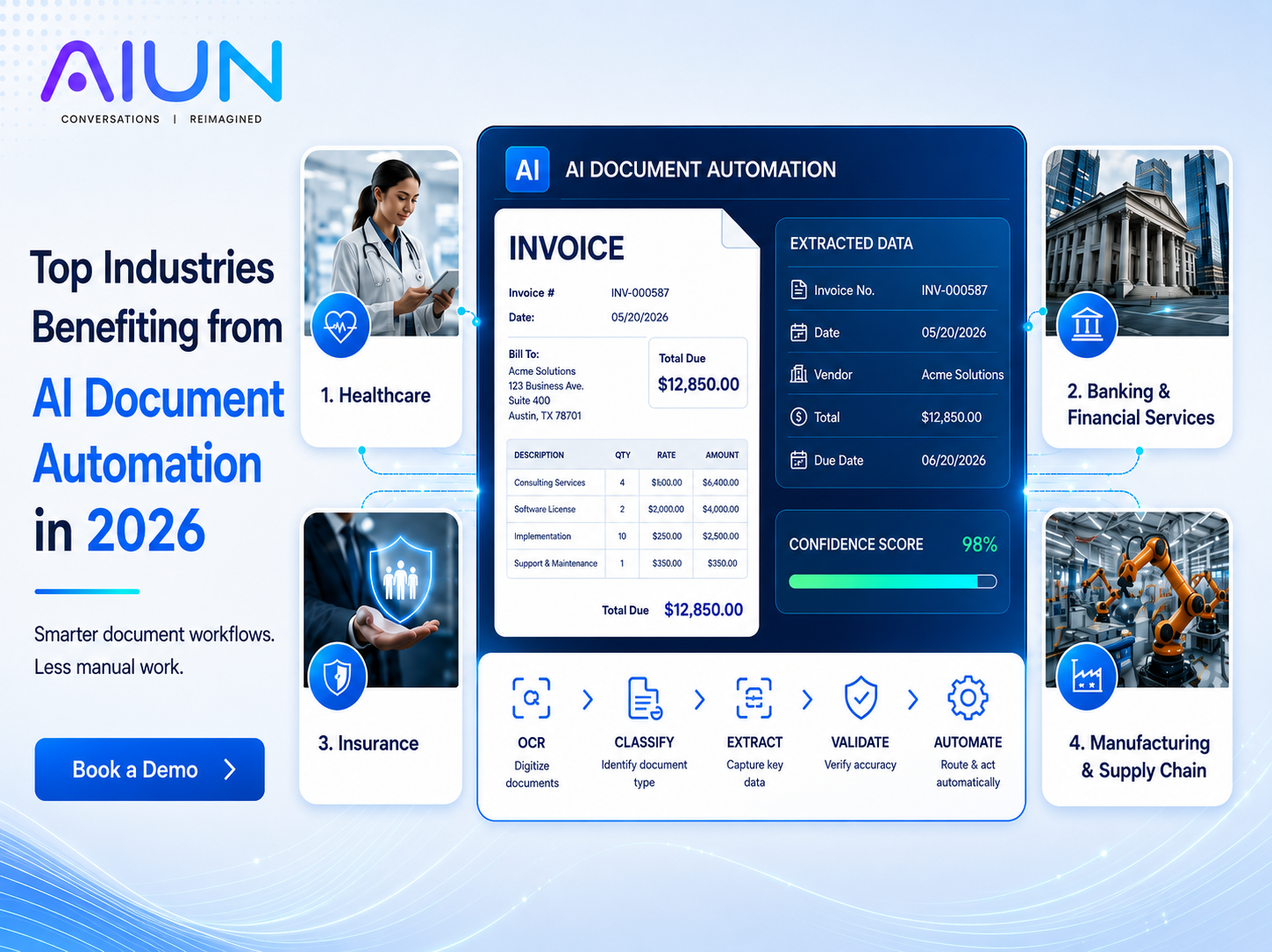
In 2026, organizations across industries are handling an unprecedented volume of business documents. Invoices, contracts, claims, forms, reports, compliance files and operational records have become central to daily business operations.
Traditional manual document handling is no longer sustainable. It slows workflows, increases costs, creates data entry errors and makes scaling difficult.
AI document automation helps businesses automatically capture, classify, extract, validate and process document data. Solutions such as AIUN Document Automation help organizations convert document-heavy processes into faster, more accurate and scalable workflows.
From Manual Data Entry to Intelligent Document Processing
AI document automation uses artificial intelligence technologies such as machine learning, OCR and intelligent data extraction to read and understand business documents automatically.
Instead of manually entering information, AI systems can:
- Capture documents from multiple sources
- Extract key data from structured and unstructured files
- Validate information automatically
- Integrate data into ERP, finance, HR or operational systems
The result is improved efficiency, reduced human error and faster business decision-making.
1. Healthcare Industry
Healthcare organizations manage large volumes of sensitive documentation, including:
- Patient records
- Insurance claims
- Medical reports
- Billing documents
- Remittance advice
AI document automation helps healthcare providers reduce administrative workload, improve data accuracy, accelerate claims processing and strengthen regulatory compliance. It allows healthcare teams to focus more on patient care rather than paperwork.
2. Banking and Financial Services
Banks and financial institutions process highly document-intensive workflows such as:
- Loan applications
- KYC documentation
- Account onboarding forms
- Compliance records
- Financial statements
AI-powered document automation enables faster data extraction and verification. It supports quicker customer onboarding, enhanced compliance monitoring, reduced operational risk and faster approval cycles.
3. Insurance Industry
Insurance companies depend heavily on documentation throughout the policy lifecycle.
Typical documents include:
- Claim forms
- Policy agreements
- Damage assessments
- Medical documentation
- Customer communications
AI document automation streamlines claim intake, document verification and information extraction. This leads to faster claim settlements, reduced processing costs and improved customer satisfaction.
4. Manufacturing and Supply Chain
Manufacturing and supply chain operations rely on continuous document exchange, including:
- Purchase orders
- Supplier invoices
- Delivery notes
- Shipment documentation
- Vendor records
AI-driven document workflow automation helps automate invoice matching, supplier onboarding and shipment validation. Invoice automation reduces payment delays, improves financial accuracy and strengthens procurement efficiency.
5. Legal and Professional Services
Legal firms and consulting organizations handle extensive documentation such as:
- Contracts and agreements
- Compliance documents
- Research files
- Client reports
AI document automation enables faster document review, clause extraction and intelligent document organization. Professionals spend less time searching through files and more time delivering strategic value to clients.
6. Human Resources
HR departments manage employee documentation across the entire workforce lifecycle:
- Resumes and job applications
- Offer letters
- Onboarding forms
- Payroll documents
- Employee records
AI document automation supports resume parsing, automated onboarding workflows, employee data management and compliance tracking. This improves hiring efficiency, reduces administrative workload and enhances the employee experience.
7. Retail and Finance Operations
Retail businesses generate significant financial documentation, including:
- Vendor invoices
- Receipts and payment records
- Purchase documentation
- Financial reconciliation files
AI-powered document processing automation helps finance teams automate invoice processing, extract payment data accurately and streamline reconciliation workflows. The result is faster approvals, fewer errors and improved financial visibility.
8. Logistics and Transportation
Logistics companies operate with time-sensitive documentation such as:
- Shipment records
- Delivery notes
- Customs documents
- Proof-of-delivery files
- Billing invoices
AI document automation accelerates document processing, reduces billing delays and improves real-time operational visibility. Automated workflows ensure shipments, payments and approvals move efficiently across the supply chain.
How AIUN Document Automation Works
AIUN Document Automation captures documents from emails, PDFs, scanned files and uploads. It uses AI and OCR to read the document and extract important details like invoice numbers, dates, amounts, customer details, claim data or vendor records.
After extraction, AIUN checks the data for missing fields, duplicates and errors. Once verified, the data can be sent to ERP, finance, HR or other business systems.
This helps businesses reduce manual data entry, process documents faster and improve accuracy across daily operations.
Conclusion
AI document automation helps businesses manage large document volumes with less manual work and better accuracy. It supports faster approvals, fewer errors and smoother workflows across industries like healthcare, banking, insurance, manufacturing, HR, retail and logistics.
With AIUN Document Automation, organizations can replace slow manual document handling with smarter digital workflows that save time, improve productivity and support business growth.
FAQ's
Q1. What is AI document automation?
AI document automation uses AI, OCR and machine learning to capture, read, extract, validate and process data from business documents automatically. It reduces manual data entry and helps teams process documents faster.
Q2. Which industries benefit most from AI document automation?
Healthcare, banking, insurance, manufacturing, legal services, HR, retail finance operations and logistics benefit most from AI document automation because these industries handle large volumes of documents every day.
Q3. How does AI document automation reduce manual work?
AI document automation captures documents from sources such as emails, PDFs, scanned files and uploads. It extracts key information, validates the data and sends it to ERP, finance, HR or operational systems without manual entry.
Q4. Why is AI document automation important in 2026?
In 2026, document volumes are increasing across industries. Manual processing creates delays, errors and higher costs. AI document automation helps businesses improve speed, accuracy and operational efficiency.
Popular Blogs

05 Nov, 2024
